
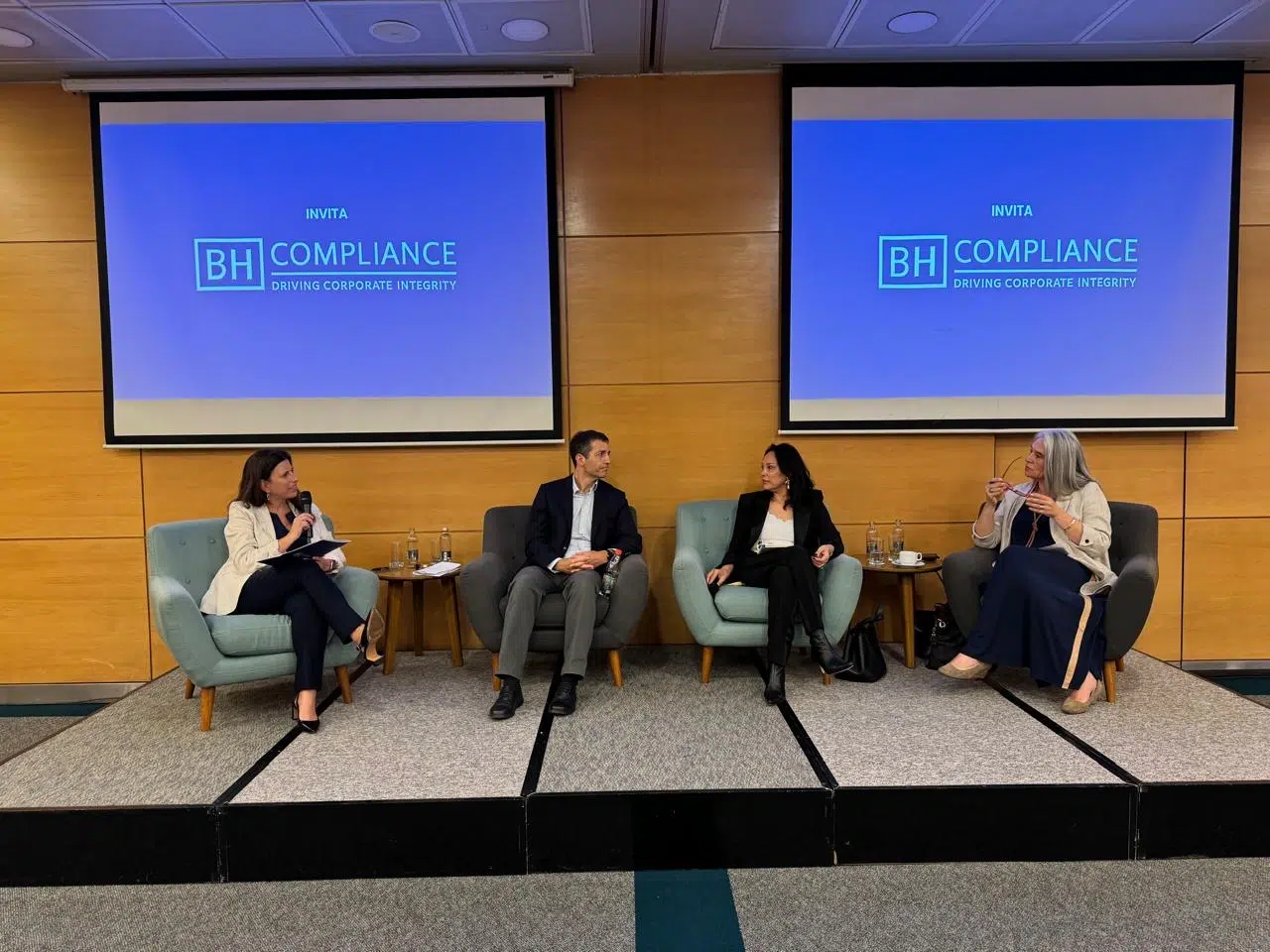
BH Compliance brought together board directors, general counsel, and compliance officers at the breakfast event “Compliance as a Pillar of Corporate Governance: Challenges for 2026”, held at El Golf 40. The event served as a space for strategic reflection on how compliance has moved beyond a formal exercise to become a central component of decision-making and organizational resilience within the corporate governance framework.
The event was moderated by Susana Sierra, CEO of BH Compliance, who opened the discussion with a reflection on the current climate of uncertainty facing organizations and the decisive role corporate governance plays in long-term sustainability. Drawing on the firm’s 15 years of experience, she emphasized that effective compliance programs cannot exist without a solid governance foundation. In this context, she highlighted the role of governance in risk management, decision quality, and stakeholder trust, underscoring the importance of measuring, benchmarking, and managing based on objective information. She noted that leadership today is not only about compliance, but about making sound decisions amid uncertainty. Based on this conviction, she explained that BH Compliance developed G-Metrix, a corporate governance framework designed to provide visibility into governance practices, offering companies a data-driven assessment and a clear roadmap for continuous improvement.
The discussion panel featured Mauricio Larraín, board director and professor at Universidad de los Andes; Jennifer Soto, board director; and Francisca Blanc, Head of Compliance and Corporate Governance at Aguas Andinas.
Within this framework, the panel identified and discussed several key elements essential to strengthening the role of compliance within corporate governance looking ahead to 2026:
Beyond the checklist
One of the panel’s clearest points of consensus was the paradigm shift taking place at the board level: compliance is no longer assessed based on the existence of manuals or policies, but on its real ability to function during critical moments. The effectiveness of a compliance system is tested when decisions are urgent, ambiguous, or uncomfortable—not when everything goes according to plan.
From this perspective, compliance risk must be treated as a material risk, on par with financial, operational, and strategic risks, and managed through robust and integrated governance structures.
Boards that deliberate
The panel was clear that the role of the board has evolved from a purely approval-based function to one centered on deep and responsible deliberation. Today, receiving reports or validating policies is no longer sufficient. Boards are expected to engage in substantive discussion, identify gaps, and challenge assumptions before making decisions.
This is what is understood as board dynamics, a critical factor in governance effectiveness. It requires examining how information flows, whether there is genuine space for dissent, and how checks and balances are exercised. When deliberation is authentic and properly documented, it not only strengthens decision-making but also protects both the organization and individual directors. Conversely, dynamics marked by silence, superficial unanimity, or “untouchable” areas do not eliminate risk—they merely conceal it, weakening the board’s strategic and oversight role.
Evidence, culture, and avoiding bureaucracy
From both regulatory and operational perspectives, the panel emphasized that the difference between “paper compliance” and effective compliance becomes evident when there is alignment between stated policies and actual practice. Indicators, metrics, gap tracking, and concrete evidence are essential for boards to exercise meaningful oversight—without falling into excessive bureaucracy. In this context, the importance of tools that enable the measurement and visualization of governance effectiveness, such as G-Metrix, was highlighted.
The discussion also underscored that a strong compliance culture is built when teams understand the why behind controls, when escalation carries no personal cost, and when compliance is aligned with incentives and performance evaluation—allowing compliance to be genuinely embedded in business operations.
Emerging risks
The panel also addressed emerging risks, particularly those related to artificial intelligence. While these technologies promise efficiency and productivity gains, the panel stressed that responsibility can never be delegated to technology. Decisions remain human and, ultimately, the responsibility of the board. Integrating these risks into the risk matrix and maintaining clear inventories of AI-supported decisions will be a key challenge for 2026.
A concrete recommendation for 2026
The discussion was opened to the audience, enriching the conversation with diverse perspectives. In closing, each panelist proposed a priority action to strengthen corporate governance in the coming year.
Mauricio Larraín emphasized the importance of institutionalizing board deliberation around material risks to prevent and mitigate them. Jennifer Soto highlighted the need to review how decisions are made during critical moments, as these are the true tests of compliance effectiveness and organizational culture. Francisca Blanc stressed the importance of empowering the compliance function by providing it with resources, trust, and strong board-level support.
The breakfast concluded with a clear message: compliance is no longer a support function or a formal requirement—it is a strategic pillar of corporate governance, and a critical driver of sustainability, legitimacy, and organizational resilience in the face of the challenges ahead.